A 2026 bowling gift guide, and the perfect game nobody has ever bowled
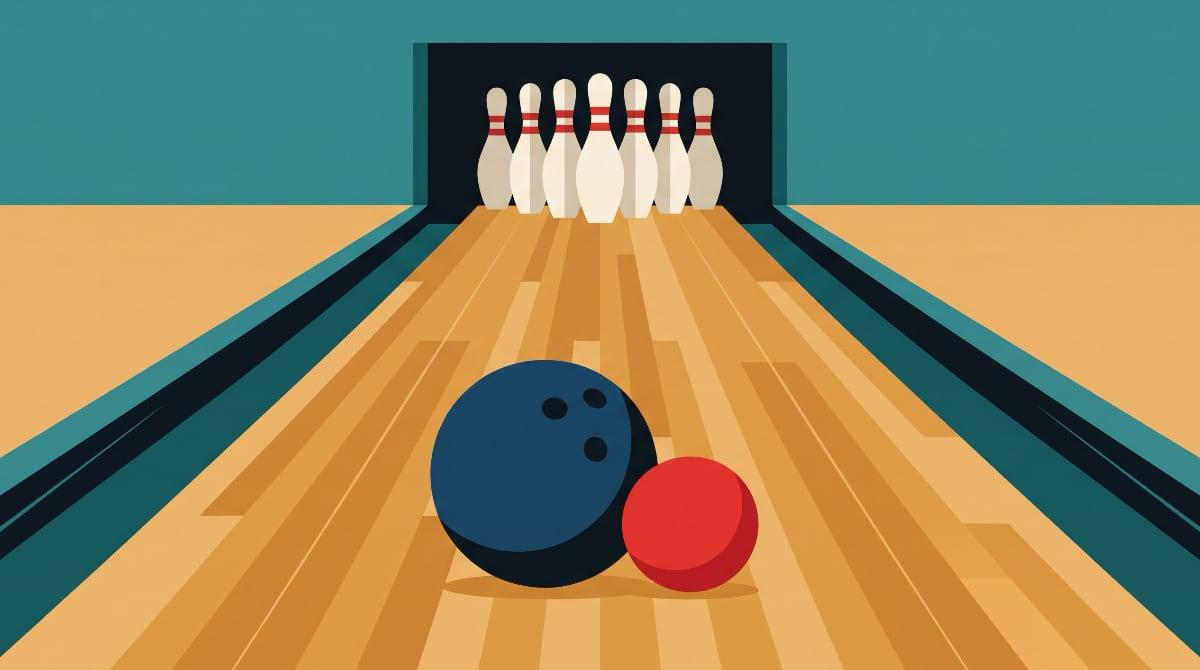
Regular bowlers rolled 55,266 perfect games in the 2013-14 season. In duckpins, a smaller version of the game that's mostly played around Baltimore, a perfect game has never been bowled.
This wishlist is for someone who bowls, whether it's a weekly league or a night out a few times a year: a ball, a bag, shoes and a shirt, a duckpin ball and an old wooden duckpin, two movies, a book, a streaming subscription and a lane night in Baltimore. The listed prices start at $40 for the book and go up to $119.95 a year for BowlTV. A ball drilled at a pro shop is priced by the shop, and a duckpin lane in the basement is for someday. Pick the items you want with "Add to wishlist," or take the whole list with the button at the bottom:
- A bowling ball, drilled at a pro shopI'll go with you, so they can fit it to my hand
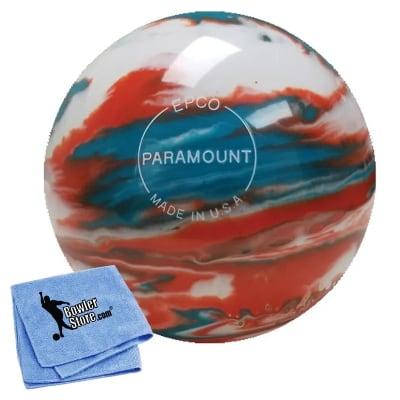
- A vintage wooden duckpinWood, so it's from before the '90s

Some links above earn WishPoster a commission. As an Amazon Associate, WishPoster earns from qualifying purchases.
The 279
The best duckpin game anyone has bowled is a 279, by Pete Signore Jr. at T-Bowl Lanes in Newington, Connecticut, on March 5, 1992. It broke a 274 bowled at Stoneleigh Lanes in Towson, Maryland, in the 1970s. Regular bowling is usually called tenpins when it needs telling apart from duckpins. A perfect game is the same 300 in both, twelve strikes in a row.
A ball the size of a grapefruit
Duckpin lanes are the same size as tenpin lanes, but the ball is much smaller. It's 4¾ to 5 inches across, weighs 3 pounds 6 ounces to 3 pounds 12 ounces, and has no finger holes. A tenpin pin weighs 3 pounds 8 ounces, give or take 2 ounces, so a duckpin ball weighs about as much as a single tenpin pin. The duckpins themselves are 9½ inches tall and weigh 1½ pounds. A duckpin bowler gets three balls a frame instead of two, but that doesn't help with a perfect game, which still takes a strike with the first ball of every frame.
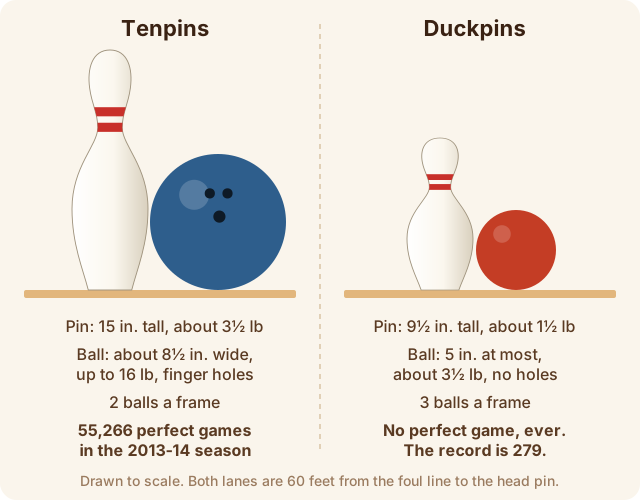
NPR has described the ball as the size of a large grapefruit. Where the game came from is less certain. In the usual story, it started around 1900 at a Baltimore alley owned by John McGraw and Wilbert Robinson of the Orioles, and the small pins flew around like ducks when they were hit. That story is disputed: there's an 1893 newspaper mention of "duck pins" in Massachusetts. Whether or not duckpins started at his alley, Robinson went on to manage Brooklyn. At spring training in 1915, he tried to catch a baseball dropped from an airplane about 525 feet up, and the pilot, Ruth Law, dropped a grapefruit instead.
EPCO, in Massachusetts, makes balls for duckpins and for candlepins, New England's other small-ball game. Its founder, Emilio Parrella, came over from Italy at 14 and worked in a hard rubber factory. The company still uses the materials and process he worked out in 1963. Make sure a listing says duckpin and not candlepin, because the balls aren't the same size.
Duckpins were made of wood, often maple, until the 1990s, when the makers switched to resin because the wooden ones got too expensive to make. So a wooden duckpin is an old one. They turn up on eBay.
The curse of Ken Sherman
Stoneleigh Lanes still sets its pins with Sherman pinsetters it installed in 1955, and nobody has made one in about 50 years. When a duckpin alley closes, the ones still open take its parts. "You cannot get a degree in fixing a Sherman pinsetter," says Nicholas Lloyd, one of the few mechanics left.
Ken Sherman, a submarine designer, came up with the duckpin pinsetter in 1953. Brunswick, the bowling company, offered to buy his patent, which would have kept the machines in production. He said no, and his company stopped making them in 1973. Duckpin bowlers call his refusal "The Curse Of Ken Sherman." Brunswick sells duckpin lanes now, and they use string pinsetters, which tie each pin to a rope. Strings are cheaper, but the ropes keep the pins from flying sideways into each other, so scores go down. Don Dove, who has won more duckpin pro tour events than anyone, said of bowling on strings, "The only way you're gonna throw a strike is if you throw it perfect."
One of the alleys that closed was Patterson Bowling Center, which opened on Eastern Avenue in Baltimore in 1927. In December 2022, regulars showed up for the 3 p.m. opening and found the doors locked. Two developers, Kristian Spannhake and Jesse Vann, bought the building and spent $2 million on it. It's now Patterson Pins: 15 apartments, a bar and two duckpin lanes in the basement. The old Shermans were "finicky and hard to repair," so the new lanes are on strings, and players get two balls a frame instead of three. People who bowled at the old Patterson can send in photos of themselves there, and they hang on the walls in silver frames.
Stoneleigh is still open, and still on its Shermans. It opened on December 7, 1946, with 16 maple lanes and a match against a team from National Brewing, the Natty Boh brewery. For its first nine years, pin boys set the pins by hand for 10 cents an hour. One regular calls the Shermans "1950s dairy machinery." He also says, "A normal game should last two beers." To book a lane, start with Stoneleigh's Facebook page or call (410) 377-8115.
The pros, and bowling on TV
The pro tour's first national championship was in November 1960 at Imperial Lanes on Summer Avenue in Memphis, where I'm from. Don Carter of St. Louis won it, averaging 237 over 60 games. Imperial had opened in 1958 with 48 lanes, open 24 hours a day. After the founder, George Long, died, his widow, Mildred, ran it his way: no alcohol, and no automatic scoring, ever. When it closed to the public in 2009, it was the oldest bowling alley still running in Memphis. I went there just a couple of times, as an adult. "Back in that time," said Bobby Muns, its head mechanic, "bowling was the thing to do. We didn't have the Internet." A gym replaced it, and its wooden lanes became the floors at Java Cabana, a coffee shop in Midtown.
Seven years later, the first perfect game on national TV was Jack Biondolillo's, on April 1, 1967, in the opening match of the Firestone Tournament of Champions finals in Akron, Ohio, on ABC. He beat Les Schissler 300-216, and ABC gave him a $10,000 bonus. (Though I watched bowling championships on TV sometimes as a kid, I never saw anyone bowl a perfect game. That would've been great to see as a kid!)
Baltimore had its own bowling show, Duckpins and Dollars, on WBAL, before it went national as Bowling for Dollars. A contestant only had to make one strike to win the jackpot, which is much harder with a duckpin ball than with a tenpin one.
Pro bowling's finals are on The CW and CBS now, and the qualifying rounds and match play stream on BowlTV, which is $119.95 a year, plus a 15% transaction fee.
Why tenpins get so many
Tenpin bowlers didn't always roll 55,266 perfect games a season. The number has gone up a lot since the 1990s, and researchers credit "reactive resin coverstocks, asymmetric ball cores, synthetic lane surfaces", along with machines that oil the lanes precisely. Reactive resin balls came out in the early 1990s, and their surface has tiny pores that soak up lane oil and grip, so the ball hooks more. The grip adds spin too. A pro shop drills the finger holes to fit the bowler's hand, and with a fingertip grip, the fingers only go in to the first knuckle, which lets the bowler put more spin on the ball.
A duckpin ball has no finger holes, so there's nothing for a pro shop to drill and no fingertip grip to spin it with. It hasn't changed the way tenpin balls have, either: EPCO still makes it with the materials and process Emilio Parrella worked out in 1963.
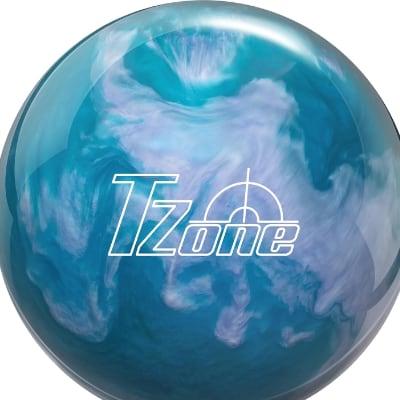
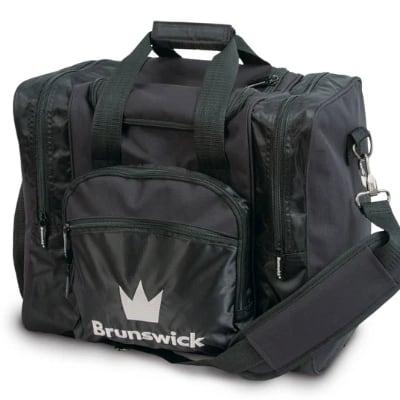
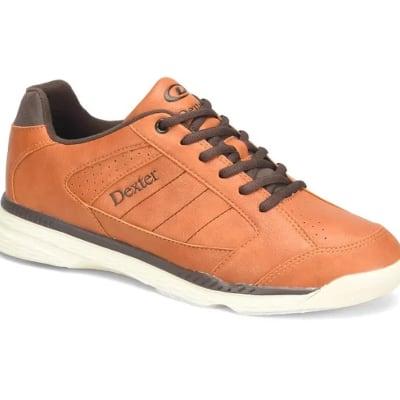
Plastic, or polyester, balls have been around since 1959 and hook less, so tenpin bowlers use them as a straight ball for some spares. The Brunswick T-Zone is one. A bowler with one ball can carry it in the Edge Single Tote, which holds one ball and shoes up to size 15. The Dexter Ricky IV has slide soles on both shoes, so a gift giver doesn't need to know which hand the bowler throws with.
Shirts, movies and a book
King Louie, a Kansas City cap maker, started making bowling shirts because, the story goes, its owner joined a league and his team needed shirts. By the early 1960s it was the largest maker of bowling shirts in the world, and its slogan was "Shoot 300 for 300 Dollars": $300 to anyone who bowled a perfect game in a King Louie shirt. For a shirt with a name on it now, Broken Arrow Wear adds one for $3.95.
In The Big Lebowski, Donny's personalized bowling shirts all have other people's names on them. The Dude is never actually seen bowling. The bowling scenes were shot at Hollywood Star Lanes, which opened in 1961, over three weeks of an eleven-week shoot.
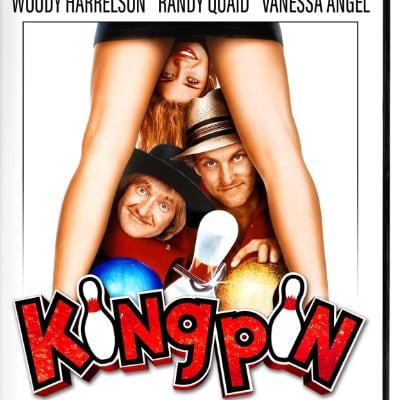
In Kingpin, Woody Harrelson bowled badly enough that coaches had to teach him to look believable, and stand-ins threw most of his shots. Bill Murray, though, threw his character's three final strikes himself. Kino Lorber's 4K came out on May 27, 2025, with the theatrical and unrated versions.
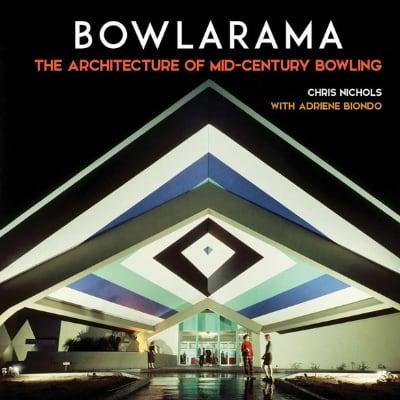
Bowlarama grew out of a 2014 exhibition about saving Covina Bowl, a 1956 alley in Southern California. Hollywood Star Lanes, the Lebowski alley, is in the book too, and that one wasn't saved: the school district took the land by eminent domain, and it closed in 2002 to make way for an elementary school. Bowling centers like these, one of the book's authors says, were "sometimes called 'the country club of the people'" because anyone could go.
In conclusion
A duckpin ball weighs about as much as a tenpin pin and has no holes to spin it with. The pins are set by machines nobody has built in 50 years, or tied to strings that lower scores. The National Duckpin Bowling Congress's record page still tops out at a 279, more than 34 years after it was bowled, and Stoneleigh, where the old record of 274 was set, turns 80 on December 7 with its Shermans still setting pins for anyone who wants to try for the first 300. Take the items that fit your bowler, or copy the whole list into a new WishPoster list with the Retro Lanes theme.
Ready to make your own wishlist?