A 2026 home gym gift guide, and how to make resistance without the weight
Around 2004, I had a little unused second bedroom, and all I wanted in it was a bench and a set of adjustable dumbbells. That was all I needed. Today I have a gym membership and use a wide variety of their equipment, but if I were a bachelor again and had some money to spend, I'd want to nerd out on whatever's out there now, as a lot has changed since 2004.
I wanted to look into home gym equipment options where you don't need massive weights to get massive gains. While the gym might have every size dumbbell and plate options, the home gym need not have it, since collecting that is costly in multiple ways. You pay to ship mass, and you pay again every time you move it. So the question is: how do you make resistance without mass?
This wishlist is for someone setting up a home gym, or someone who has one and likes unusual equipment: a motorized cable machine, adjustable dumbbells and a bench, gear built on springs and flywheels, a sand kettlebell, a stall mat, three books and a few sessions with a coach. The listed prices start at $35 for a hand gripper and go up to $2,199 for the cable machine, which also needs a mount. Pick the items you want with "Add to wishlist," or take the whole list with the button at the bottom:
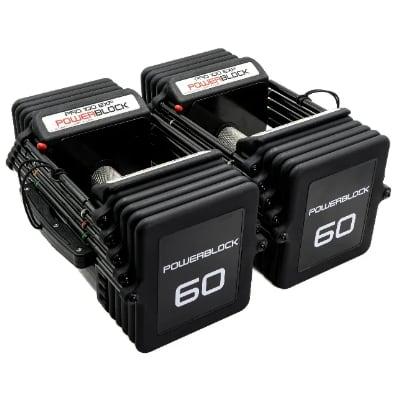 PowerBlock Pro 100 EXP adjustable dumbbellsThe 5 to 60 pound set. The heavier stages can come later.$758
- A folding adjustable benchSomething sturdy that can stand against a wall
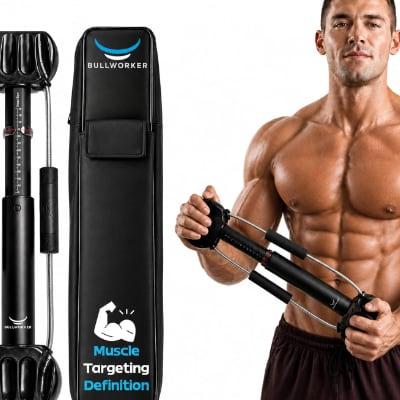 Bullworker Steel Bow
- Horse stall mat4 by 6 feet, 3/4 inch thick. Help carrying it would be nice.
 The New Encyclopedia of Modern Bodybuilding
 Total Recall, by Arnold Schwarzenegger
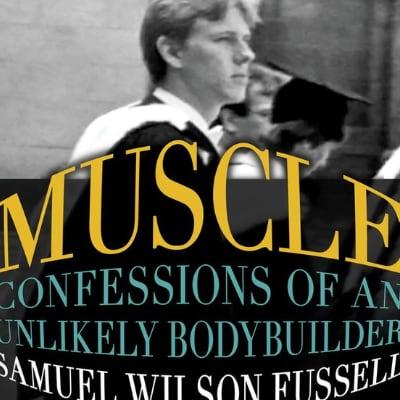 Muscle: Confessions of an Unlikely Bodybuilder
- A few sessions with a strength coachTo show me how to use all of this without hurting myself
Some links above earn WishPoster a commission. As an Amazon Associate, WishPoster earns from qualifying purchases.
775 pounds of dumbbells
The adjustable dumbbells I bought around 2004 were Bowflex SelectTechs. The SelectTech 552 has 15 settings per dumbbell, from 5 to 52.5 pounds. Buy a fixed pair at each of those weights and you'd have 775 pounds of iron to ship, store and carry up the stairs. The adjustable pair is about 105 pounds. (I just found out there's a recall on a lot of SelectTechs because the plates can come loose, so I'll be looking into that.)
The adjustable dumbbells on this list are PowerBlocks, which use a U-shaped pin to pick the weight. According to the company, Carl Towley woke from a dream one night in Santa Cruz having seen a compact dumbbell that could replace an entire rack, and PowerBlock started in 1993 in an unheated workshop in Owatonna, Minnesota. Garage Gym Reviews now calls them "historically some of the most durable." They're sold in stages, so the 5 to 60 pound pair on this list can get heavier later.
No gadgets or contraptions
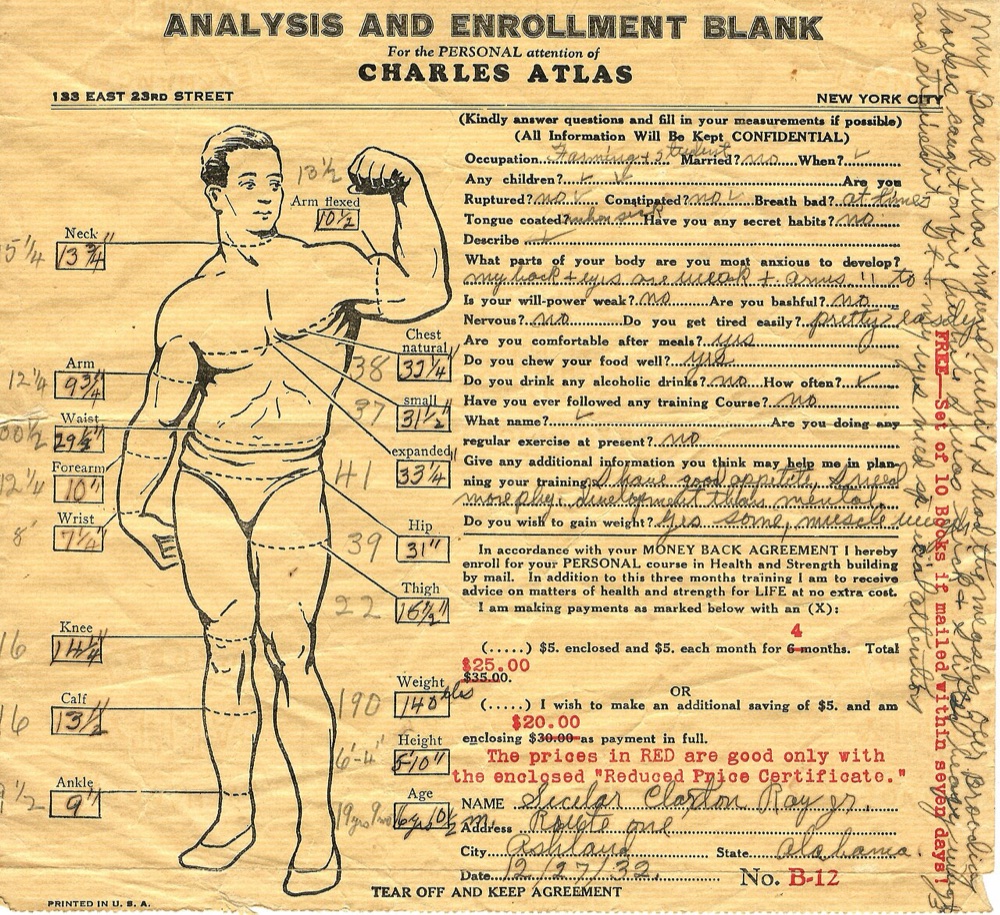
An enrollment form from December 1932. Wikimedia Commons, CC0

In December 1932, a teenager in Alabama who listed his occupation as farming and student filled out this form. He was signing up for the most extreme way to make resistance without mass: a course with no equipment at all. The form asks "Is your will-power weak?" (no), "Do you chew your food well?" (yes) and "Have you any secret habits?" (no). Next to "Breath bad?" he wrote "at times." The $30 price is crossed out in red and replaced with $20.
The boxes hold his measurements, including 140 pounds and a flexed arm of 10 and a half inches. Someone has penciled bigger numbers beside them: 190 pounds and 13 and a half inches. They look like targets, though the form doesn't say who wrote them or why. If they are targets, one of them is a height of 6 foot 4, next to the 5 foot 10 in the box.
The man selling the course was born Angelo Siciliano in Italy in 1892 and moved to Brooklyn in 1904. A friend told him he resembled the statue of Atlas on top of a Coney Island hotel, so he took the name Charles Atlas. He made it legal in 1922, the year the magazine publisher Bernarr Macfadden named him "America's Most Perfectly Developed Man" at Madison Square Garden.
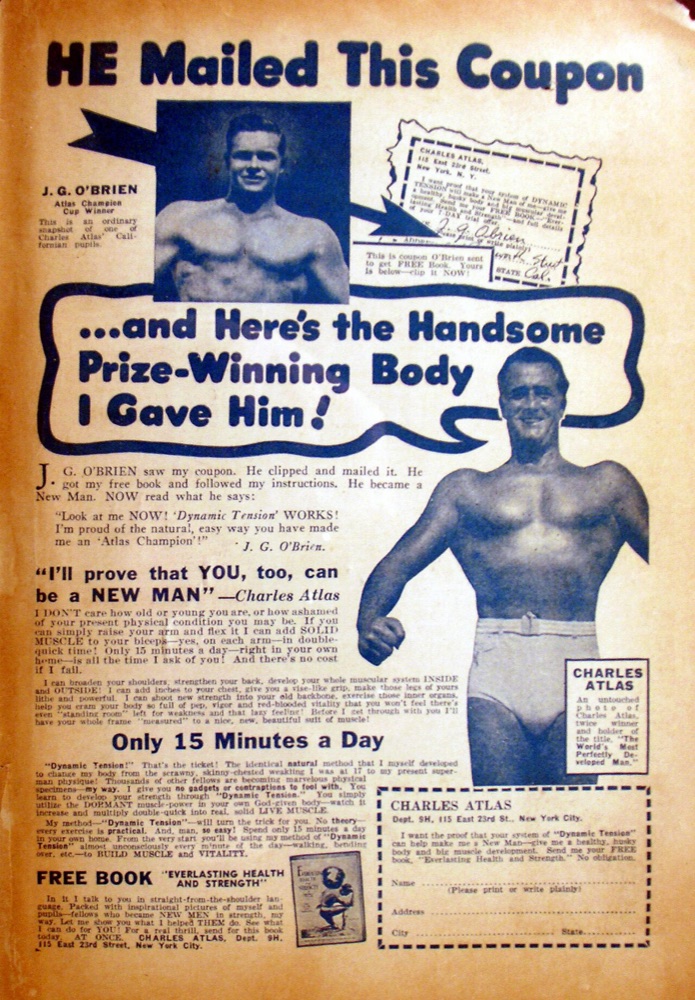
From Weird Tales, September 1941. Wikimedia Commons, public domain

He called the course Dynamic Tension, and it put tension on the muscles without machines or free weights. His ads promised "no gadgets or contraptions to fool with" and "only 15 minutes a day." It was twelve lessons and one final perpetual lesson, with photos of Atlas demonstrating the exercises. Everything it shipped was paper, which makes it the lightest home gym in this post.
The ads that sold the course were built around the "97-pound weakling," a phrase coined in 1928 by an ad man named Charles Roman. In the ads, a bully pushes around a skinny guy in front of his girlfriend, she joins in, and he goes home and sends away for the free Atlas book. Then he comes back muscled, confronts the bully and gets the girl back while onlookers admire him.
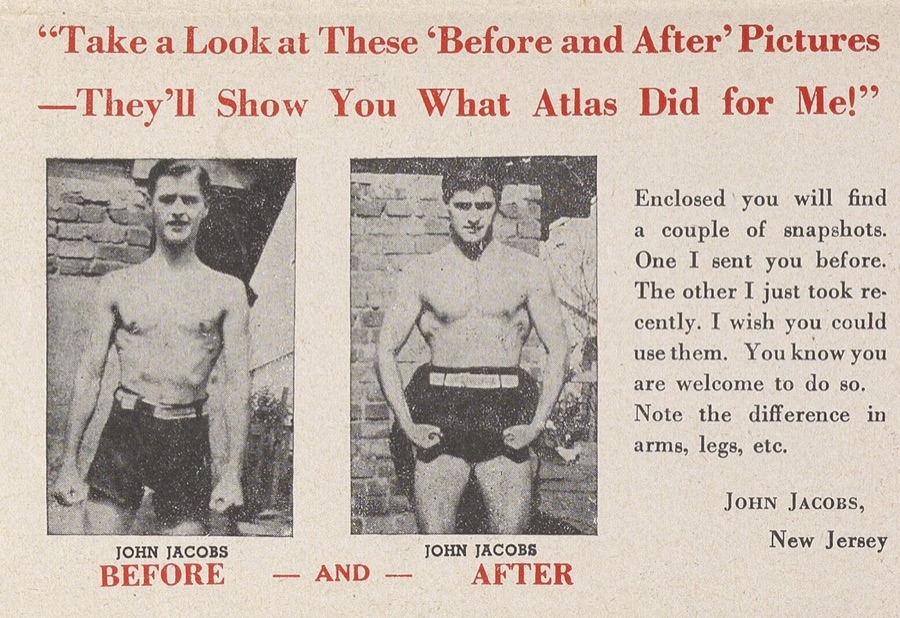
From an undated Charles Atlas brochure. Wellcome Collection, CC BY 4.0

Atlas's brochures were packed with letters and snapshots from customers. One headline in this brochure reads "His Personality Developed ALSO." Another man is "Now Able to Sleep." A customer in South Africa reports that his constipation "has mysteriously disappeared after the first application." The company picked which letters to print, so they show what it thought would sell a course.
The before and after that got me
Before-and-after pictures were still selling exercise about 70 years after Charles Atlas's 97-pound weakling. Bill Phillips's Body for Life came out in 1999 with them inside. The agent who sold the book told Outside, "The idea to include the before-and-after pictures was Bill's." The book had sold 3.5 million copies by 2003. I read it, I watched the video, I bought all the Myoplex and I got really into the gym. It sort of worked.
The Myoplex was Phillips's too. He bought EAS, the supplement company whose flagship product it was, in 1996. Wikipedia says the money Phillips would have made from the book went to the Make-A-Wish Foundation. The book still paid off for EAS: Outside reported that EAS credited about 20 percent of its $300 million in annual revenue, or about $60 million a year, to people doing the Body for Life challenge.
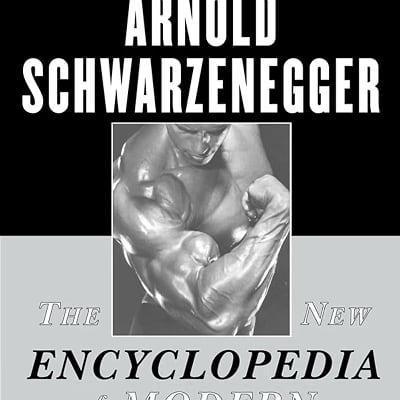
Body for Life isn't on this list, but three other books are. In Muscle, Samuel Fussell, a blue-blooded and storklike Oxford graduate, arrives in New York and spends 1985 to 1988 as a dedicated bodybuilder, steroids included. Total Recall is Schwarzenegger's memoir, which goes from Austria to bodybuilding to the movies to the governor's office. The New Encyclopedia of Modern Bodybuilding, by Schwarzenegger and Bill Dobbins, is the manual. It runs about 800 pages and is subtitled "The Bible of Bodybuilding."
Springs that went to space

Koichi Wakata on the space station's spring-based exercise machine in 2009. NASA, public domain

A dumbbell weighs nothing in orbit, so nobody needed resistance that didn't come from weight more than NASA did. After Shannon Lucid came back from a long stay on Mir in 1996, the agency went looking for ways to stop muscle and bone loss in space. Paul Francis, an architect turned inventor, had been building gym equipment around steel springs, and he'd found they "would start breaking at about 10,000 cycles." He switched to a spiral spring made mostly of rubber, called it SpiraFlex, and won NASA's competition. The machine was ready for the station's first crew, with up to 300 pounds of resistance.
Francis then licensed SpiraFlex to Nautilus, the company behind my SelectTech dumbbells, for its Bowflex Revolution line.
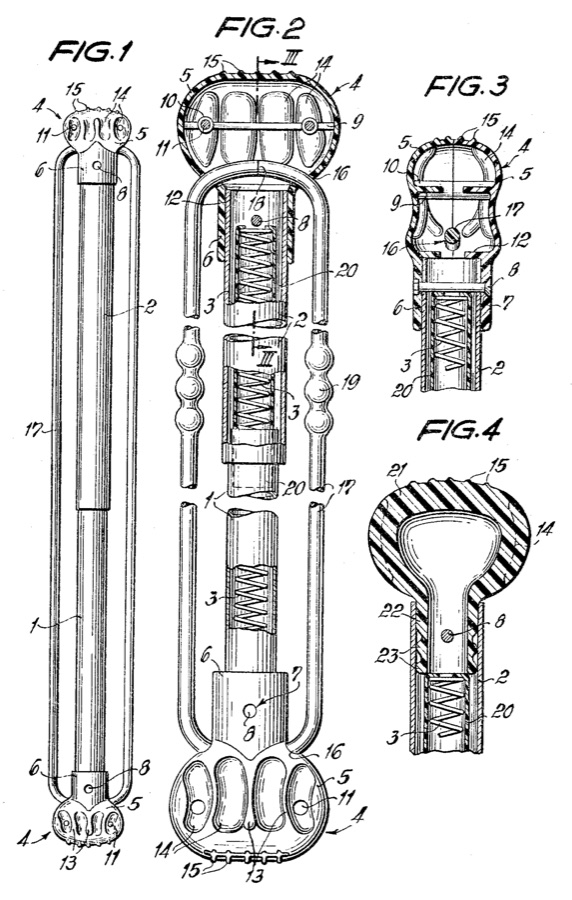
Gert Kölbel's patent drawing. Wikimedia Commons, public domain

A Brooklyn man named Arthur Pons patented a spring-loaded telescoping exerciser in 1912. Fifty years later, Gert Kölbel created the Bullworker, a similar tube with grips and cables, and it sold through the fitness craze of the 1960s and 1970s.
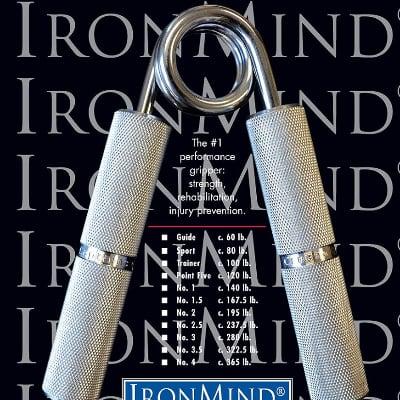
Until I started on this post, I didn't know what a gripper was. It's a V-shaped spring you hold in one hand and squeeze until the handles touch. IronMind makes the Captains of Crush line, and the No. 4 takes 365 pounds to close. In 1991, the company certified Richard Sorin as the first person to close the easier No. 3 under official conditions, and the list of people who've done it now has 318 names. The official conditions include starting with the handles at least a credit card's width apart, which is checked by sliding a credit card between them. The No. 1 on this list is rated at about 140 pounds, so someone new to grip training may want a lower one.
The wheel that doesn't need gravity
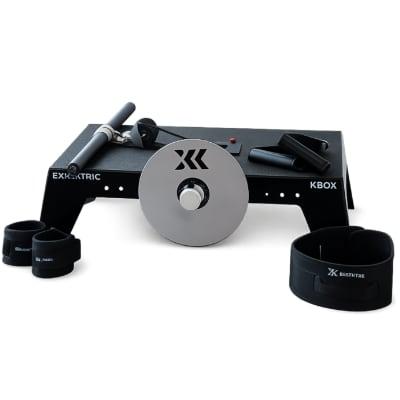
Fredrik Correa and Mårten Fredriksson coached different age groups at the same ice hockey club. Their young players "were strong and talented, but many had little experience with free weights," and the time spent learning to lift limited how much load the coaches could use. While working on research projects at the Karolinska Institutet in Stockholm, Correa came across a flywheel prototype.
Karolinska scientists had been building flywheel devices since the late 1980s, with support from ESA, NASA and the Swedish National Space Board, to fight muscle and bone loss in space. A flywheel relies on inertia, so it works independently of gravity. The coaches wanted the versatility of free weights with a flywheel for resistance, and they released the first kBox in 2011. The platform weighs 22 to 35 pounds.
Some of the weight can wait
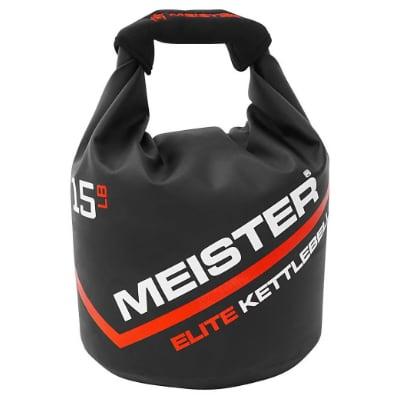
A sand kettlebell ships empty, and the listing says a 50-pound bag of sand runs about $4 at a home improvement store.
The floor doesn't get to be light. Thick rubber absorbs the impact of dropped weights and protects the subfloor, which is how a horse stall mat ends up in a home gym. A 3/4-inch, 4-by-6 mat weighs about 94 pounds, so it takes a truck and two people.
The motor
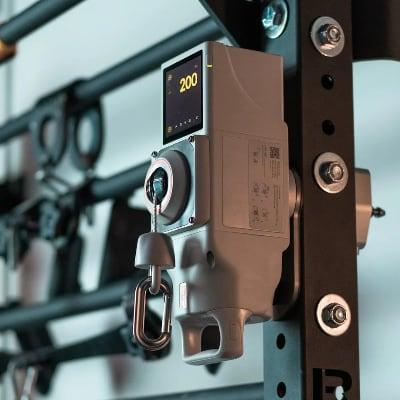
I heard the VOLTRA cable machine referenced on a podcast, looked it up and thought, wow, that's genius. Someone doesn't have to have a bunch of plate weights to do cable-based weightlifting with it, and it's even portable. The company used technology in a compelling way to get there.
Beyond Power's VOLTRA I swaps the weight stack for a motor. It weighs about 13 pounds and pulls from 5 to 230 pounds. That's more than twice the load of the 105-pound dumbbell pair from earlier, in about an eighth of the weight. The company describes it as a machine that "generates force instead of lifting mass." Since the force comes from software, the machine can behave like plates, like a band or like a rower's damper, depending on the mode.
It has also gotten stronger since people bought it. A firmware update in October raised the limit from 200 pounds to 230, and the modes have gone from three at launch in 2023 to eight.
It has to be mounted to something, and no mount comes in the box. Accessories are starting to appear, including a rack bracket from a small outside maker and a dock from Beyond Power that owners can build their own mounts around.
The US warranty is 12 months, and returns are 14 days, unactivated only, so a surprise gift has a short window. Beyond Power's page has shown it as both "Available Now" and "Sold Out," so confirm it's in stock before promising one by Christmas.
The company claims 14 days of battery life, but the Garage Gym Reviews tester said, "I think I could squeak maybe three sessions out of it." An owner who checked in after a year said it had "survived freezing winters and 90-degree humid summers," with some fan noise in the heat and minor fraying on the cables.
The motor itself isn't a new idea. The Swedish doctor Gustav Zander opened his first exercise institute in Stockholm in 1865, and by the 1890s some of his machines ran on electric motors.
In conclusion
A hundred years ago, Charles Atlas's answer to making resistance without mass was no equipment at all, and around 2004 mine was a pair of adjustable dumbbells standing in for a rack of iron. Today a motor pulls 230 pounds and weighs 13, but the horse stall mat on this list still weighs about seven times what the motor does. Take the whole list and it comes with a new Weightlifting theme, or start your own.
Ready to make your own wishlist?